Robots in Disguise by Darius Ridgel
My first impression of Chicago was probably through the Michael Bay-directed action film, Transformers 3: Dark of the Moon. From that movie, plus what little else they teach you about the place in Alabama, I gathered that Chicago is just a place that gets obliterated every once in a while, whether by fire or Decepticon. I won’t lie, I have noticed since moving here a certain hardihood in the city’s natives ostensibly borne of a culture from a place that has burned down before. But where I’m from, we like things the way they are. In Birmingham, we say, “it is what it is.” But Chicago replies, “it doesn’t have to be.” And I’ve struggled with that response. I mean, with getting my Bachelor’s and the big move, I’ve changed more in the last year than any other in my life. I would love nothing more than some familiarity.
In the midst of the chaos of my first Chicago Summer™, I was guided through the Waypoint triptych installation by its co-creators, Ross and Elizabeth Fiersten, and I finally recognized myself. The exhibition was staged at Nick Cave’s and Bob Faust’s Facility Gallery, and the proprietors’ experimental energy was on full display. The entire building instilled in me a certain rascalliness, like I’d stumbled upon a bunker of kids with no adult supervision. It was an affective haze of collections, rotating gallery exhibitions, and a production studio–the veil between each being at best a single wall or pane of glass.
But the whole Waypoint exhibition was visible from Facility’s exterior, which definitely added to the novelty of the experience. From there it was easy to appreciate the appeal of Ross’s solo piece in the exhibition, On Balance. Despite the surrounding walls, the sum of each waxed aluminum and powder-coated steel bar defined its own space in multiple ways. For one thing, the installation was meant to be experienced throughout its interior, and the kooky geometries of each round rail made traversal something like a game, perhaps an iconographic reference to Ross’ skating hobby. Even more winsome is that each pipe also housed a joint upon which the entire contraption could pivot. Beyond being the exact kind of concept-forward, designo work that targets my artistic sensibilities in particular, I felt the whole thing radiating that Chicagoan sense of prerogative.
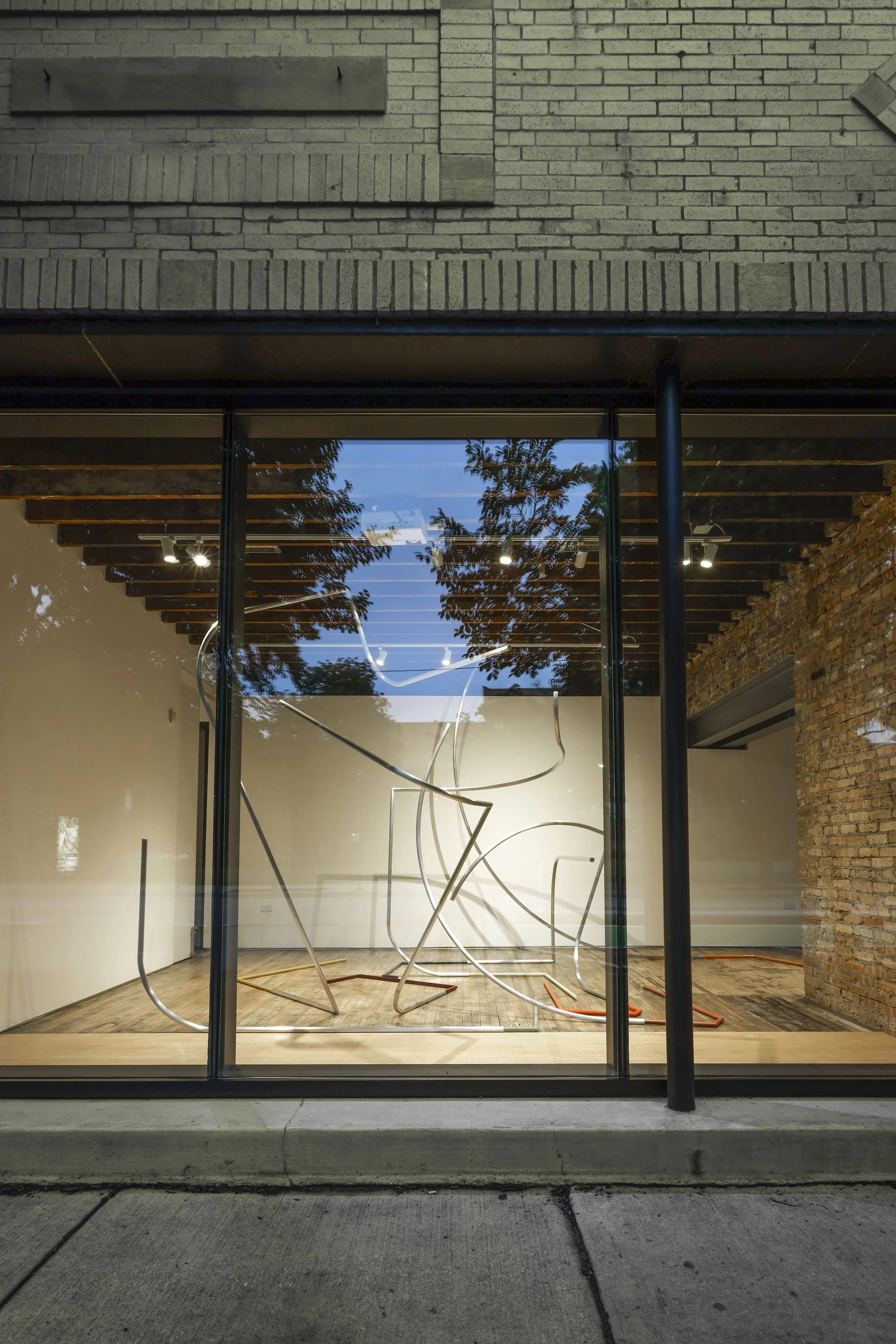
Exterior view of On Balance by Ross Fiersten. Photo by Paul Strabbing.
Contrastingly, Elizabeth’s solo-piece, Swag, struck me as something more quotidian, being inspired by her childhood home of Santa Fe. Being from the Iron City myself, I’m quite comfortable around industrial materials like steel, which–rather than taking center stage like On Balance–punctuated the corners and infrastructure of Facility’s north gallery. Framed by its street-facing window, the exhibition’s pooling metallurgies appeared synonymous with the surrounding environment, upon which I could gaze from a floor to ceiling window (the architectural seal of many a Chicago building). And despite the additional material, everything still belonged. Some ferrofluid tucked itself into corners; some dangled from the ceiling; some sexual; some celestial; all grinning and bearing hand-treated, acid-wash patinas that dredged their surfaces in the inaugural summer heatwave of the Super El Niño. Evidently, each chalybeate form was designed to be site specific. I felt safe there.
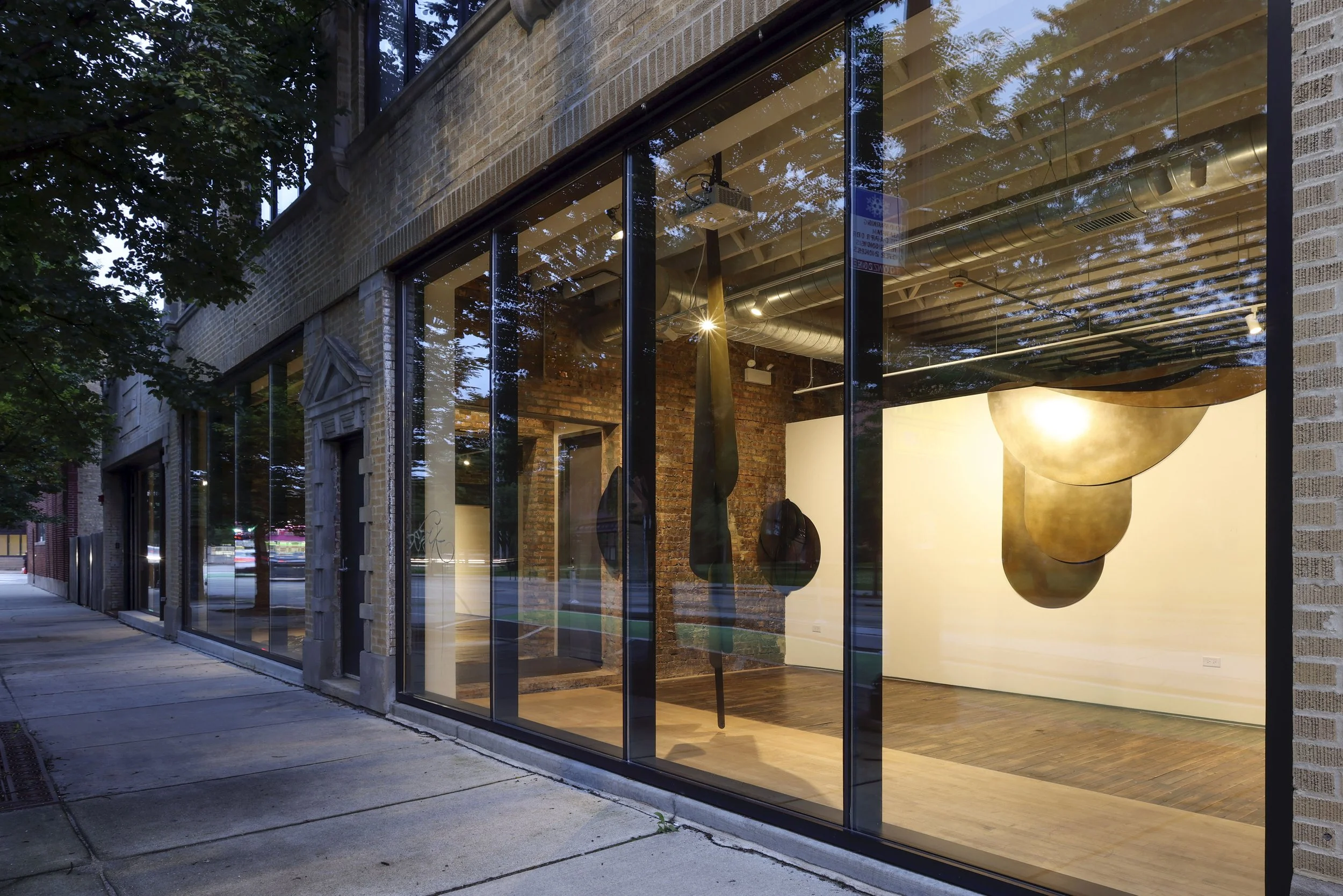
Exterior view of Swag by Elizabeth Fiersten. Photo by Paul Strabbing.
As the name might’ve suggested, Waypoint was where Ross’ and Elizabeth’s contrasting creative visions truly converged. A throng of steel plates welded together in bundles teemed at my feet in front of the center gallery window. Each “wave” was designed to be rearranged spontaneously throughout the exhibition, and the rippling arcs of each fusible crest were water-table-cut with verisimilitude.
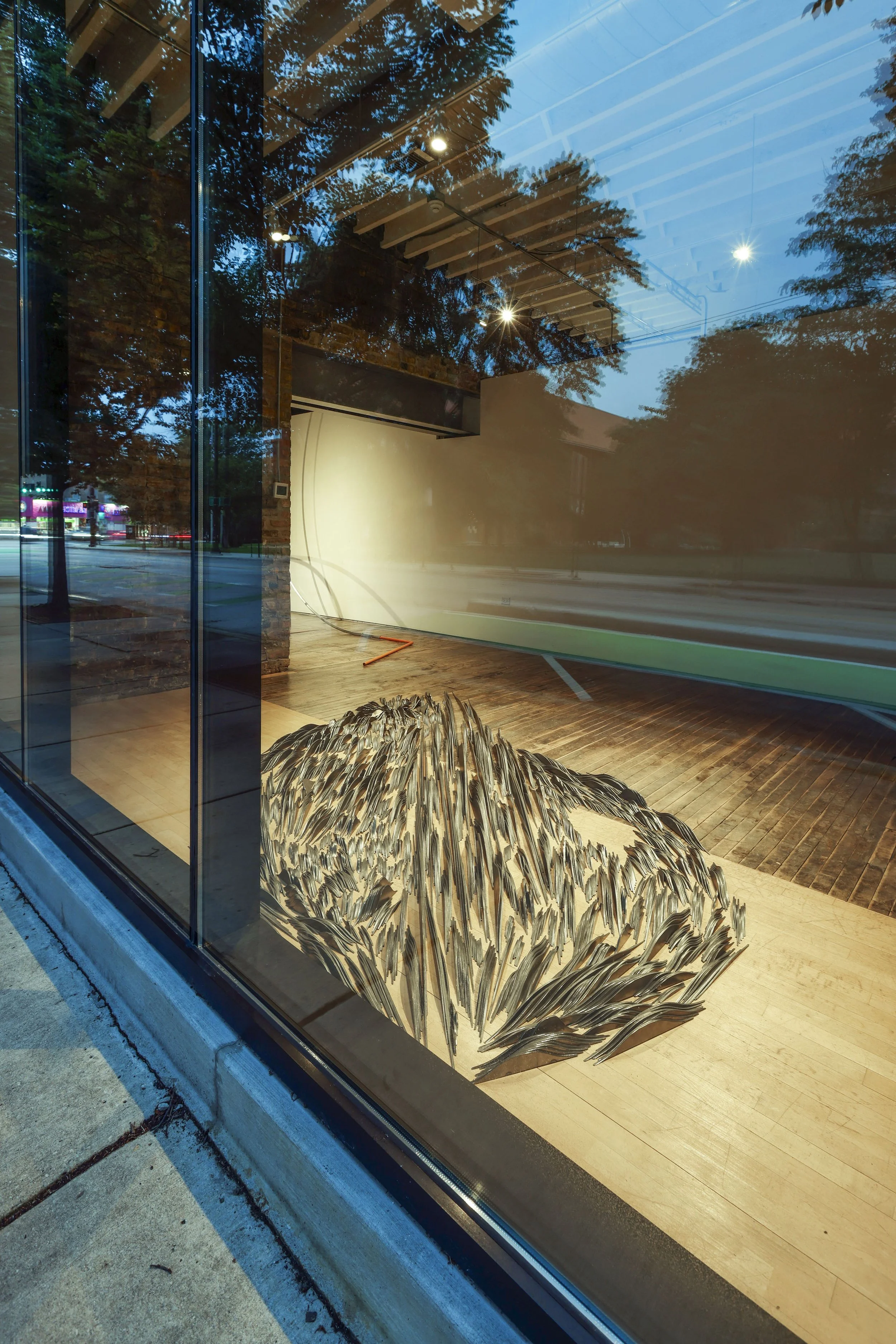
Exterior view of Waypoint by Ross and Elizabeth Fiersten. Photo by Paul Strabbing.
In the symbolic sense, the discourse of water and steel is of great cultural significance in the City of Big Shoulders, down to the Fiersten’s themselves. Fittingly, “waypoint” is a term often used in sailing, another one of Ross’ avocations. A waypoint is a stop on a route between two locations, or a moment of inflection, or a point of reference–to know where you are going and where you’ve been. It’s a nod to a story of a duo that is dog-eared with experiences both on the water and in their metal studio, Manifold. And just as Waypoint, the Fiersten’s collaboration piece, anchors the whole exhibition, Chicago is the aggregate of the intersecting cultures and experiences of tens of millions of migrants and regional transplants throughout history.
I suppose that history includes myself now, too, though I’m still having trouble believing it. Life in this city can be anything I want it to be, and I’m infatuated with possibility, but commitment is another thing. For as much positive change as I have experienced, I miss feeling like I was interacting with the world on my own terms.
I miss my own avocations. As a kid, I was obsessed with Transformers. Once in a blue moon, I would scavenge a new Cybertronian from the toy aisle as recompense for waiting around in a big box store for my mom to make 6 months worth of returns. And beholding the pageant of the supermarket’s wares, possibility felt fun. I felt safe there. I don’t know if I feel safe anywhere anymore. I feel like I’m from Cybertron.
We hide so much of ourselves in pursuit of ‘growing up.’ Now, standing in my swanky new Chicago apartment room, looking out my reasonable-length window, and seeing all the swag I’ve collected throughout my life tucked into its corners and hanging from its ceilings, I’m beginning to yearn to reconnect with that which reminds me of myself. The Waypoint exhibition embodied that interplay to me, between safety and possibility, between water and steel. If I can find the balance, I think Earth is gonna be a good home for me after all. I just gotta find something to do around here, like go to graduate school or write a gallery review.
Bio
Darius Ridgel is a graduate student in the Master of Arts Administration and Policy (MAAAP) program at the School of the Art Institute of Chicago. He graduated from the University of Alabama in Huntsville with a BA in Studio Arts in 2025. He served as his undergraduate university’s first Exhibition and Installation Coordinator within Lowe Mill Arts & Entertainment Center, as well as a long-term Committee Member for the university’s Association for Campus Entertainment. His artwork won the Presidential Award in the UAH Annual Juried Student Exhibition. His skills include event production and management, exhibition curation, and artmaking of many forms. (dridge@saic.edu)